In the hallowed chambers of Paris Haute Couture Week, where history often precedes innovation, Manish Malhotra chose to paint the runway red—the color of life, of blood, and of the primal heartbeat. His monumental debut, "Maa," is far more than a collection; it is a profound exercise in fashion symbolism, transforming thirty years of industry mastery into a poetic, tactile eulogy for his mother, Garima Malhotra. This is where high fashion transcends the aesthetic to become a metaphysical dialogue between a designer and his muse.
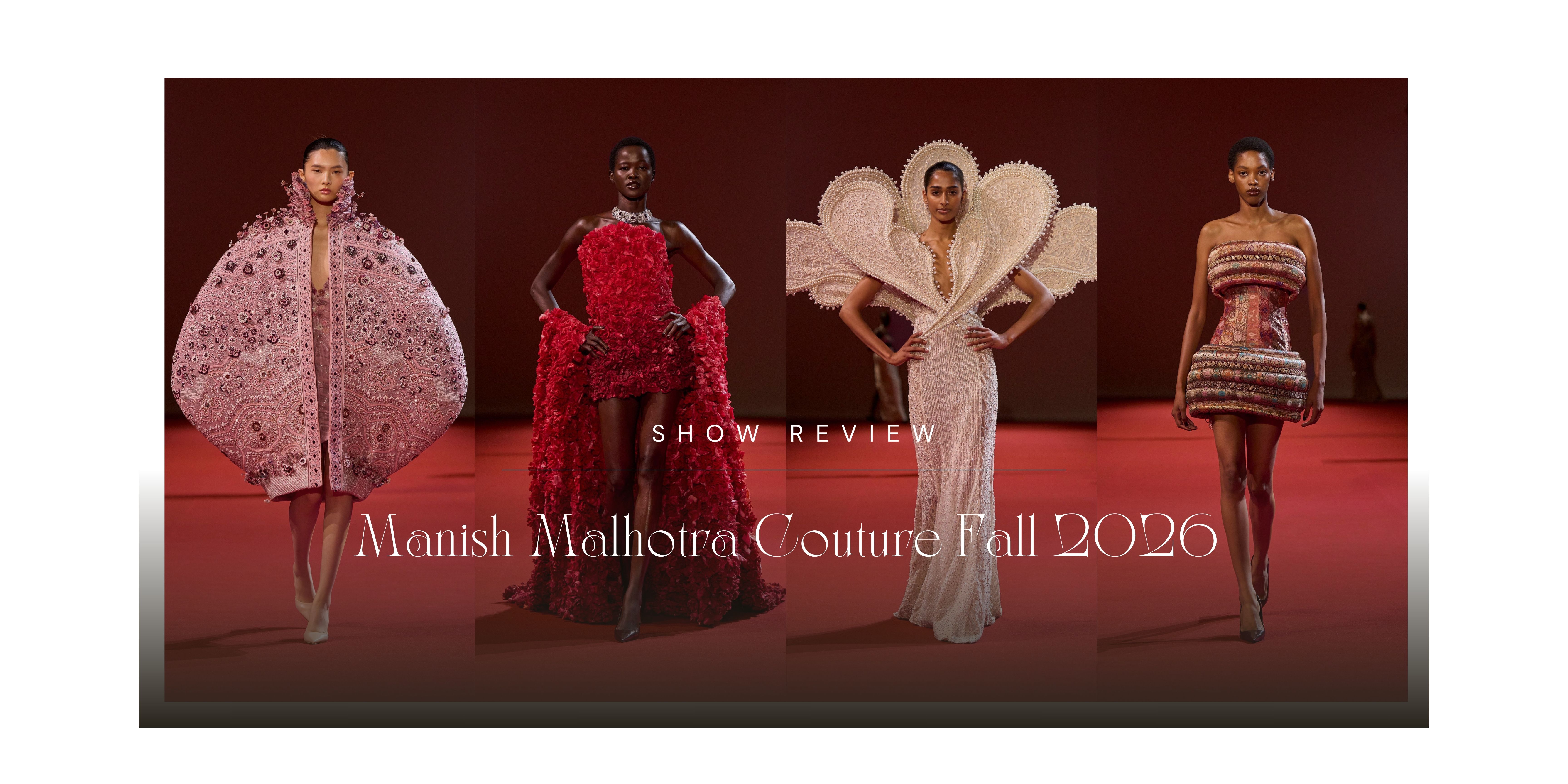
As you observe the collection’s opening, it becomes clear that Malhotra is providing one of the most poignant fashion storytelling examples in recent memory. By centering his narrative on the matriarchal figure, he challenges the traditional boundaries of couture. To understand how to interpret fashion symbolism in luxury collections, one must look beyond the silhouette to the intent. The red runway serves as a symbolic umbilical cord, connecting the designer’s Bollywood heritage with the architectural rigor of Parisian couture. It is a masterful runway narrative that celebrates both Indian craftsmanship and a deeply personal matriarchal tribute.
Act I & II: From Cocooning to the Bond
The first movements of the collection are visceral. Malhotra explores the early stages of motherhood through "Cocoon," characterized by architectural balloon forms and oversized, protective proportions that suggest a sanctuary. As the show transitions into "Bond," the garments become more structural, utilizing knotted constructions that visually represent the inextricable link between mother and child.
https://www.youtube.com/watch?v=DUQr6F-8J4U

In these early acts, Malhotra masterfully utilizes symbolic clothing examples to evoke emotion. The "Cocoon" silhouettes are not merely avant-garde shapes; they are sculptural silhouettes that mimic the womb’s protection, offering a lesson in representing motherhood through fashion design motifs. As you watch the movement of the heavy, draped fabrics, you see architectural tailoring meeting old-world glamour. The "knotted" techniques used in Act II serve as a literal and figurative embodiment of connection—the "Bond"—where the fabric itself seems to hold a memory of touch, showcasing the semiotics of fashion in its most protective form.
Act III & IV: Becoming and the Abundance of Legacy
As the narrative progresses, the collection shifts from the collective experience of motherhood to the emergence of the individual. "Becoming" and "Legacy" introduce a vibrant explosion of color and metallic textures, drawing heavily from the 1970s—the era of his mother’s prime. This section is a masterclass in incorporating family legacy into custom fashion garments, as Malhotra reimagines the Kanchivaram saree through a contemporary, global lens.
https://www.youtube.com/watch?v=m22ZpgTwcgM

The semiotics of fashion are most loud in the finale, where floral appliqués and heritage textiles represent the "Abundance of Legacy." For the luxury investor, these pieces are the pinnacle of bespoke artistry. The use of metallic gold and silver threads, inspired by the luster of traditional Kanchivaram silks, elevates the collection to a celebratory peak. It is here that Malhotra proves his prowess in fashion symbolism, using the visual weight of the garments to represent the gravitas of a life well-lived. Each look is a testament to how personal history can be woven into the very fabric of high-end design, making it a compelling study for anyone looking for storytelling through fashion examples for designers.
The Craftsmanship: Zardozi meets Invisible Architecture
Beyond the emotional resonance lies a technical feat that defines this couture debut. To support the immense weight of traditional Indian craftsmanship, Malhotra utilized invisible internal corsetry—a "metaphysical connection" between the soft emotions of the theme and the hard reality of garment construction.
This collection provides a comprehensive guide to indian embroidery techniques for storytelling. The application of Zardozi embroidery and Resham work is not merely decorative; it is narrative. Zardozi, a centuries-old technique involving metallic threads, is used here to create textures that feel ancient yet modern. The intricate beadwork and "Salli" (glass tube) embellishments are applied with such precision that they appear like liquid light on the runway. This confluence of bespoke artistry and heritage textiles ensures that each piece remains an investment in culture as much as it is an investment in fashion.
A Masterclass in Symbolic Couture
Manish Malhotra’s "Maa" is a definitive moment for global fashion. It successfully bridges the gap between the vibrant emotionality of Indian culture and the refined structure of Paris Haute Couture. By employing deep fashion symbolism, Malhotra has created more than shoes and gowns; he has created a visual language for the soul.
As we analyze the semiotics of fashion throughout this four-act odyssey, it becomes clear that "Maa" is a blueprint for representing motherhood through fashion design motifs. It is a celebration of the feminine force, captured through Indian craftsmanship and delivered with a Parisian flair. For the modern collector, these pieces are not just garments—they are wearable legacies, echoing the heartbeat of the red runway long after the final model has exited.